
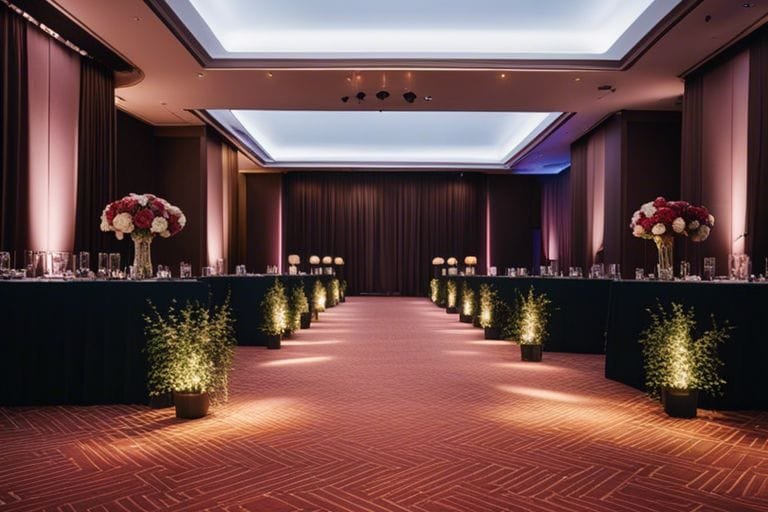
Lighting is the cheapest way to change how a room feels, and the easiest thing to get wrong by ignoring it entirely. A gala venue lit only with its house lighting reads as a conference room with catering; the same room with a proper lighting plan reads as an event. Here’s how to think about lighting a corporate gala properly — and why some of it is backed by more than just opinion.
Color temperature isn’t just aesthetic — it changes how people feel
Research on color temperature and mood consistently finds that warmer light (around 2700–3000K, the amber-ish tone of a traditional bulb) reads as more relaxing and pleasurable, while cooler light (5000K and above, closer to daylight) increases alertness and arousal. A restaurant-lighting study found guests rated warmer 2700K lighting as noticeably more pleasant than cooler 5600K lighting in the same space, while the cooler light produced measurably higher arousal.
For a gala, that’s a practical planning tool, not trivia: dinner and networking areas generally benefit from warmer, lower-intensity light that encourages people to relax and linger, while a stage, dance floor, or awards moment can use cooler, higher-contrast, more dynamic lighting to lift energy at the right point in the evening. The mistake to avoid is lighting the whole room the same way regardless of what’s meant to happen in each part of it.
Uplighting is the easiest high-impact change
Battery-powered, wireless uplights placed around a room’s perimeter, columns, or feature walls are one of the highest-impact, lowest-effort lighting additions available — no running cable across a venue floor, no reliance on house power near every fixture, and they can be repositioned in minutes if the room layout changes. Colour-matching uplighting to a brand palette or event theme is a simple way to make a fairly neutral corporate venue look considerably more deliberate.
Why the venue’s own lighting usually isn’t enough
Most venues are lit for function — even, flat, bright enough to read a menu — not for atmosphere or for photography. Flat overhead lighting tends to produce flat, unflattering photos, which matters more than it sounds for a corporate event where the photos are often used afterwards in company communications or on social media. Purpose-built event lighting (spotlighting, wash lighting, uplighting, and targeted accents) gives a room depth and shadow that generic venue lighting doesn’t.
LED has made this more practical, not just prettier
Modern event lighting is almost entirely LED-based, and it’s worth knowing why beyond energy savings: US Department of Energy testing puts LED lifespan at roughly 25,000–100,000+ hours before meaningful light loss, depending on the fixture — at typical usage that’s well over a decade of service, which is part of why LED rigs have become the standard for repeated corporate use rather than one-off installs.
Where the trends are heading
Beyond static wash and uplighting, moving-head fixtures, projection, and synced lighting-to-music cues are increasingly common at galas that want a moment — an awards reveal, a product unveil, an entrance — to feel produced rather than just illuminated. These are worth budgeting for selectively, on the two or three moments in an evening that actually need them, rather than spread thin across the whole room.
Planning a gala or corporate event?
We design and run lighting as part of full corporate event production — alongside audio, video, and staging. Read more on how it fits into the bigger picture in our AV planning guide, or get in touch to talk through your event.